Showing posts with label law. Show all posts

Tuesday, November 4, 2014

Racial Bias in Boston and New York 


       A study was published recently that highlighted an important problem with the Boston Police Department.  The study shows that 63.3 percent of people stopped by officers are black.  This number is particularly disturbing because black people account for only 24.4 percent of Boston's population.  The data of over 200,000 stop-and-frisks was gathered over a four-year period and reminds us that racial profiling is still an issue.  This chart from the Huffington Post illustrates that the vast majority of people stopped are black. 


       The stop-and-frisk law allows an officer to search a person for contraband as long as the officer has a reason to believe that the person was going to commit a crime.  However, "The Boston reports showed, instead, that in three-quarters of all police-civilian encounters, the officer's stated reason for initiating the encounter was simply "investigate person"".   This means that officers have often been targeting people to be stopped-and-frisked for no reason other than the fact that they are black.  Because so many people are targeted without the officer having a legitimate reason to suspect them of criminal activity, most people being investigated are innocent.  The article states that "only 2.5 percent of those stop-and-frisk procedures resulted in the seizure of contraband".  This incredibly low number shows that stopping-and-frisking a person is often a waste of time.  The stop-and-frisk law does not help to catch criminals, it mostly just disrupts the lives of innocent people.

       The Huffington Post article relates the incidents in Boston to a similar case in New York City.  New York City's "broken windows" policy "focuses on aggressively enforcing quality-of-life offenses to deter more serious ones".  Similar to the stop-and-frisk encounters in Boston, 81 percent of all violations were issued to black and hispanic people.  The summonses are most often given out in black and hispanic areas of the city.  In some cases, over 10 percent of all people in black and hispanic areas have been given summonses.  This highlights the racial bias that is very prevalent in the city's police department.  Black and hispanic people are much more likely to be stopped-and-frisked in Boston and given a summons for a quality-of-life offense in New York City.


the Perceived Threat of Blackness


   On August 5th 2014, 22 year old John Crawford III was shot and killed by two police officers in an Ohio Walmart. The police were on the scene responding to a 911 call reporting the presence of Crawford, walking through Walmart carrying a BB gun at the time, was threatening to the other shoppers. Shortly after his murder, however, holes began to form in the story of the police timeline. In late September surveillance footage released ("conveniently" after a grand jury trial absolved the involved police officers from facing indictment) shows that the responding officers shot Crawford almost immediately, contrary to their insistence that they only shot after he repeatedly refused to lay down his gun. The man who called 911, Ronald Ritchie, recanted on his version of the story after viewing the footage. Finally Ohio is a state with fully permissive Open Carry laws, meaning that anyone with no criminal history, substance dependence, or history of  involuntary commitment to a mental institution can openly carry a firearm in public.

http://www.theroot.com/content/dam/theroot/articles/culture/2014/08/family_claims_ohio_father_was_shot_dead_by_police_in_walmart_over_toy_gun/walmartjohncrawfordmug.jpg.CROP.rtstoryvar-medium.jpg

John Crawford III

   A similar tragedy unfolded in Utah on September 10th when 22 year old Darrien Hunt was shot to death by police responding to a complaint of a suspicious person with a sword. Police claim that Hunt lunged at the officers, however eye witness reports say he did not move until fleeing after being fired upon, an account supported by an autopsy showing the entry wounds to be in his back. Not only would the visible carrying of a sword be fully legal under Utah's Open Carry laws, but the alleged sword itself was a blade less souvenir used for part of a costume.

http://cdnph.upi.com/sv/em/i/UPI-9471410789327/2014/1/14107930809493/Mom-Darrien-Hunt-was-shot-because-he-was-black.jpg

Darrien Hunt

    In both of these killings we see police responding to legal and harmless actions with extreme force,  despite the fact that white Americans perform the same actions with actual weapons on a regular basis. As we've covered in our discussions of The New Jim Crow, part of this phenomenon can be explained by the institutionalized racism prevalent in the War on Drugs era, but psychological studies published earlier this year suggest that these assumptions are more internalized than just law enforcement prejudices.

   In The Essence of Innocence, a study published this past March, a group of psychologists explored how two predominantly White test groups, one made up of college students the other consisting of police officers, perceived young boys based on race. The test subjects were shown a series of photos of boys, ages roughly 10 to 13 and of several different races, each with a crime they were supposedly suspected of. They were then asked to estimate the age of the boy as well as his culpability (how responsible he was for his actions, how likely he was to continue criminal behavior, how likely it was that he didn't intend the negative consequences of his actions, and how well he could take care of himself). The study showed that in both groups Black boys were deemed on average to be both the most over estimated in age and deemed the most culpable.

Age Overestimation and Perceived Culpability responses from the college student group.

Age Overestimation and Perceived Culpability responses from police officer group.


In addition to the testing procedure the officers involved also had their on-the-job record of use of force against criminal suspects. The group most often targeted by such violence was Black suspects.

Number of use of force incidents per officer

    This study shows psychological evidence that people in American society not only hold internalized misconceptions about the maturity of Black boys, but that it starts at a disturbingly young age. The study's authors note that when suspected of a felony "boys would be misperceived as legal adults at roughly the age of 13 and a half". Worse still is at "every age level after 10, black boys were considered less innocent than either white or unspecified children". These findings help provide explanation for the recent spate of police slayings of Black young adult civilians, but if police and White America can't fix this lack of empathy then we can only expect this trend of apathetic violence to continue.

Sources Cited:
Goff, P., Jackson, M., Leone, B., Culotta, C., & Ditomasso, N. (2014). The essence of innocence: Consequences of dehumanizing Black children. Journal of Personality and Social Psychology, 526-545.

Bump, Philip. "People - Including Cops - See Black Kids as Less Innocent and Less Young Than White Kids." The Wire. The Wire, 10 Mar. 2014. Web. 4 Nov. 2014.

Murdock, Sebastian. "New Video Shows John Crawford Fatally Shot By Police In Walmart." The Huffington Post. TheHuffingtonPost.com, 24 Sept. 2014. Web. 4 Nov. 2014.

Swaine, Jon. "Utah Authorities Alter Account of Darrien Hunt Shooting by Police." The Guardian. Http://www.theguardian.com, 16 Sept. 2014. Web. 4 Nov. 2014.

Monday, October 20, 2014

Supreme Court aid the Racial Disparity in the Death Penalty

During the first post, I suggested that the death penalty was racially biased and to dig deeper, I need to explain why. Racial disparity in the death penalty is shown throughout history; with the Supreme Court help, those who violated the constitutional rights of victims can get away with the crime if the criminal is white or if the victim was white. Looking at the graph below, one can see that white victims (more than 75%) are seen as more important to the Supreme Court (the court who justifies if one deserves the death penalty) than any other race. The Court considers to take cases with white victims.


In the article, How the Supreme Court Protects Bad Cop, the article tells several events when the Court favours the cops by constantly denying that the black victims’ rights were violated. In the end, by the Court favouring cops and white victims this has created a racial disparity in the death penalty because those who are put on the death penalty are mainly men of colour. Along with police immunity by the Court, the attorneys are also held a huge amount of power. It was shown in a recent studied, as stated in The Colour of Justice, when attorneys “approved for the death penalty prosecution, 72 percent involved minority defendants” (5). Without directly stating racism, the Court found a way to indirectly keep racial disparity even when it comes to the death penalty by giving the police immunity and attorneys a great deal of power by denying the violation by the police and attorneys.

With this in mind, we now go to the death of Michael Brown. The topic that’s been in the news for months, and continues, is the indirect racism underlying Michael Brown’s death. When the Missouri cop, Wilson, killed Brown, people demanded justice. Just from this simple action by the people took shows that inequality is present when it comes to the death penalty. Wilson should have immediately been sentenced to jail if not the death penalty because Brown’s rights were taken away from him. However, as of today, the cop still did not go on trial to see if he had the rights to kill a young man instead of finding an alternative way of dealing with the situation. Since Wilson is a cop and is white, the chances of him going on the death penalty let alone serving any jail time is very slim thus the reasoning for the uproars and/or protests of demanding justice which the picture below shows.


Just as in Ferguson, there is a higher chance for justice if a white man was a victim than if a black man was a victim. In the article, How the Supreme Court Protects Bad Cops, Chemerinsky details several events when a/some white cop(s) killed a black male without much of a punishment. One of these cases were the Plumhoff vs. Rickard when a high speed chase started and a police officer believed shooting the car would be the best method thus killing the driver and the passenger. The Supreme Court ruled that the police had a valid reason for shooting the car and if necessary policemen can shoot cars during chases until the car stops. Rather than shooting the tire(s) the police immediately jumped to this idea. However, instead of getting the death penalty because the two victims were stripped of the constitutional rights in many ways, he and other cops actually gets encouraged to shoot cars during chases and to continue shooting until the chase is over.

Learning about the immunity of cops and the attorneys' power from the Supreme Court and in the New Jim Crow, and in the article, “How the Supreme Court…” I see that the outcome of the Ferguson trial when started will be disappointing for most because there is a higher chance for the Supreme Court to deny the violation. Racial disparity is only growing when it comes to the death penalty because blacks mainly men are having their rights taken away from them when they are victims in a murder by the Supreme Court when the Court denies the violation of the criminal if white and excuse him from death row.


Bibliography

"Racial Disparities." Death Sentence Focus. Webite. Assessed October 20 2014. http://www.deathpenalty.org/article.php?id=54

Chemerinsky, Erwin. "How the Supreme Court Protects Bad Cops." New York Times. 2014. Website. Assessed October 20, 2014. http://www.nytimes.com/2014/08/27/opinion/how-the-supreme-court-protects-bad-cops.html?module=Search&mabReward=relbias%3Ar%2C%7B%222%22%3A%22RI%3A18%22%7D

"Colour of Justice." Constitutional Rights Foundation. 2014. Website. Assessed October 20 2014. http://www.crf-usa.org/brown-v-board-50th-anniversary/the-color-of-justice.html

"Tension in Ferguson." Vox. 2014. Website. Assessed October 20 2014. http://www.vox.com/2014/8/11/5993609/michael-brown-ferguson-shooting-protests-riots-police-violence-unarmed


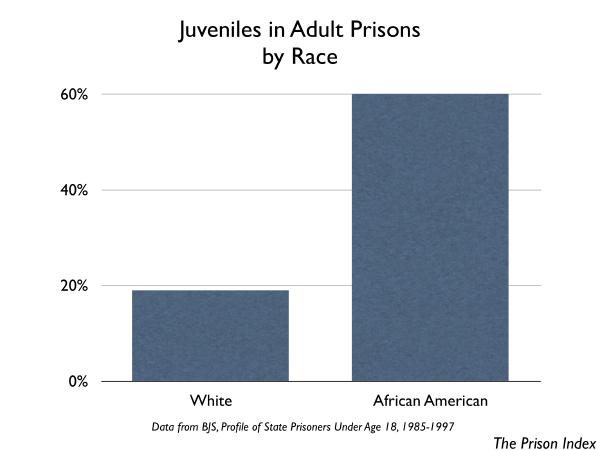
Juveniles in Adult Prisons

Black and Hispanic Juveniles in Adult Prisons

 The first blog posted was about the unequal sentencing between races and now this blog post is about the disparities between juveniles in adult prisons between races. In the 1900s, juvenile justice systems were created to stop the youth from becoming criminals. The Juvenile system tried to prevent youth from continuing to be involved in illegal activity by changing their mindsets so that they would become productive adults in society. Although the system was created to help the youth, it has over- represented minorities in the system. The juvenile system has created racial disparities. A system that was created to help improve the lives of the youth seems to have targeted minorities and has actually been harmful for the growth of the youth in these communities. These systems that have inequality are also extremely harmful because once the youth are sent to various places such as adult prisons they become labeled as second class citizens starting at a very young age.
For few races the juvenile system is an intervention for the youth, while many minorities experience the juvenile system as a way to label the youth as criminals at an early age. The youth that are sent to adult prisons due to the disparities, cause the youth to become actual criminals because they are placed in situations where they are living among real adult criminals that were sent to prison for serious crimes. Due to the fact that a lot of the youth are exposed to real criminals in adult prison, when they get out if they get out they have the tendency to become criminals because of their expose. The racial disparity in the juvenile system is that white youths are being sent to rehabs or detention centers while minority youths are sent to adult prisons with harsh sentences. 

The juvenile system has even gone as far to have disparities between the numbers of black and hispanic youths going straight to adult prisons.  Minority youths are disproportionately sent to adult courts and adult prisons more likely than their white counterparts. This is harmful to the community because the youth are viewed as criminal, which helps to support the stereotypes that there are more minorities committing crimes. These stereotypes are the reason why more minorities are stopped, frisked and arrested. Due to the disparities, minorities  youths are going to adult prisons and being sentenced as adults, while whites are getting let off with a lighter consequence and more opportunities to change their fate in society.


Wednesday, September 24, 2014

Police Practices

Enforcers of law. Protectors of the city. Figures of justice. Who do these phrases describe? Do these pictures of friendly looking police jog up your memories? 

Are these the type of police your parents told you about as children; are they the ones who protect your neighborhood, the “good guys (or gals)” who fight the "bad guys (or gals)," and the ones who respond to 9-1-1 when trouble eschews? If so, that's great! If not, well, that's not so great. Then are you more familiar with these images? 


When people think police, they tend seem them as symbols of justice and power. Yet with recent events such as with the shooting of Michael Brown in Ferguson, Missouri, the raising issue of police brutality is sweeping through the nation. There is increasing tension between the police and public as many feel that this brutality, this injustice needs to be stopped and controlled. This is an ongoing conversation about police overstepping their boundaries and using their power over citizens. 

Over the years there have been multiple police practices in question such as:
·   Racial profiling 
             (ex. Stop-and-Frisk policy)
Why is this happening? Is it a fundamentally racial issue or is it a departmental issue with training and job expectations? Arrest and ticket quotas are essentially the minimal expected number of arrests and tickets an officer has to make within a period of time. When several NYPD officers spoke out about this practice, it sparked a fury  in the already controversial Stop-and-Frisk policy. The policy was getting noticeably biased towards the large number black and hispanic citizens being stopped compared to their fellow white citizens. Why is that? What makes a police more likely to stop a black or hispanic off the streets than a white? The most common reason is: he/she looked suspicious. Given that most people would probably feel uncomfortable having anyone (let alone an officer) stare at you, this argument holds up poorly. Such reasonings also weaken the tie between community and police force because discrimination and stereotypes leads to mistrust. Police should have a reasonable idea the amount of force needed to handle a situation. This also includes the militarization of some police departments. While some reason they are to control riots, at the end of the day the only thing left in place is the continuing fear and confirmation bias of police excess force. 

How does this relates to our SOC 230 class: Race is still a big issue today! A survey conducted in August 2014 by the Pew Research Center and USA TODAY found that most Americans gave "low marks to police departments for holding officers accountable for misconduct, using the appropriate amount of force, and treating racial and ethnic groups equally" (Pew Research Center). While there is a mixture of reasons why the police received meager scores, having staggering differences in racial disparities in the makeup of the force can lead to a lack of community communication. There is much prejudice and discrimination between the police and public at times because everyone is wary of each other whether or not they admit it. Community relations between the local police and public is important because trust is necessary to protect a safe environment. If everyone is judging each other's potential violence by their skin color or clothing then this idea of "race" will continue to be ingrained into our minds.ere is much prejudice and discrimination between the police and public at times because everyone is wary of each other whether or not they admit it. 

References:
Lippmann, Rachel. "Fuel In The Ferguson Fire: Racial Makeup Of Police Force Makes A Difference." St. Louis Public Radio. N.p., 14 Aug. 2014. Web. 25 Sept. 2014. <http://news.stlpublicradio.org/post/fuel-ferguson-fire-racial-makeup-police-force-makes-difference>.
"Police Practices." American Civil Liberties Union. N.p., n.d. Web. 25 Sept. 2014. <https://www.aclu.org/criminal-law-reform/police-practices>.
Stark Racial Divisions in Reactions to Ferguson Police Shooting." Pew Research Center for the People and the Press RSS. N.p., 18 Aug. 2014. Web. 23 Sept. 2014. <http://www.people-press.org/2014/08/18/stark-racial-divisions-in-reactions-to-ferguson-police-shooting/>.


Death Penalty: Racism Hidden Within


DEATH PENALTY-THE WAY TOWARDS PERFECTION

How would you react if you read everywhere: Death Penalty-The way towards Perfection!! In the 1600’s to late 1700’s using the hanging method for public execution was acceptable, and actually authorized by the colonies of past America, when someone did a crime against the state, person, and property. For the past-people of America, hanging was a method for the death penalty was seen as a way towards perfection. Hanging allowed the world to slowly become pure again by diminishing the corrupt. Not only did they hang their criminals, but it was in a public setting, allowing the offender to be humiliated before dying. However, around 1800’s to the 1900’s dramatic changed took effect.

Lynching was seen as a public practice that happened consistently.
Before their deaths, the offenders would be shouted at, and maybe even attacked
physically and emotionally before dying. It was like a show; in the picture you
can see: couple holding hands, a pregnant lady, a man pointing at the hanging men
while smiling, and so much more
Our former Americans realized that public execution may not be the best for the country. Public execution started to seem ordinary, trite, common, overused, and simply fun. While the men who are hanged in the above picture had killed a white couple, the public going to see the hanging does not prove to be justice, it proves that America is corrupt in thinking. Watching a hanging was seen as watching a movie. It became something that could be seen as a daily doing that shouldn’t be taken seriously. The authorities of America decided that this practice was indeed serious so limited the public to only those who were official witnesses to be in the realm of the execution. 

Past-people of America also recognized that there were two types of murder: first and second degree. They started to sort out which crimes went into what category. As well as realising the difference in murders, they also realised that their definition of criminals to be hanged was unclear. The solution: they started to list what crimes should and should not be under capital punishment. Now, the crime to be punishable by death did not include stealing a loaf of bread. 

The three pictures in the chronological order of a inmate being strapped into an electric chair
and electrocuted. Notice that the inmate was black and those surrounding
him were white. Thus concluding that his family members most likely
were not there and could possibly have not even had the chance to say goodbye
This was during the early 1900's.
With many improvements, also came unclear thinking when the electric chair and lethal gas were methods of the death penalty during the 1900’s. Something so barbaric was thought of only a century ago and was still being used only 30 years ago and may even be used today. While the crime he committed might have been inhumane itself, giving justice does not mean inhumanely killing a man. If so, in a sense, the executor himself is corrupt: isn't that ironic. 


Most states have the lethal injection as the only option for capital punishments. Some countries
still use gas chambers and even firing squads as a practice. However, it is calming to see that
most countries adopted the lethal injection of no death penalty. However, some may think otherwise.
Now, however, the majority of states use lethal injections for a death penalty (look at above picture). However, even a lethal injection can become dangerous when used incorrectly and ignorantly. An example: Clayton Lockett, a very recent death penalty. Lockett was executed for killing a young girl and raping her friend. When given the injection, it is said his vein collapsed and 45 minutes after, he had a heart attack. While most may say he deserve every punishment he gets, whether purposely done or not, the fact that others who are on death sentence might have to go through the same pain if the injection isn't done correctly is terrifying. (This link takes you to a botched lethal injection of Clayton Lockett: http://www.nydailynews.com/news/crime/friends-victim-zero-sympathy-clayton-lockett-inmate-botched-okla-execution-article-1.1777463)  


Picture of Lockett the year of his execution. He committed the crime
when in 1999, when he was 23, got the
execution when he was 38 in 2014. 

Why might someone care about those who are on a death sentence when it is justice: because sometimes those who are being executed shouldn't be. There are many accounts when people got off of the death sentence because the trial was reopened, and they found that the "offender" was non-guilty. However, there are more who aren't so lucky. For those who are being wrongly accused either accidentally or purposely should at least die a non-painful death. 


The history about capital crime was a roller-coaster when deciphering what was the appropriate crime committed to be executed and what was the appropriate execution method. Even today, it is still a grey area that constantly needs to be updated and conversed about in order for it stay humane.

http://www.pewforum.org/2014/03/28/executions-state-by-state/
(The link above takes you to a map that shows the numbers of death penalty for each state beginning in 1977 until 2014.)

Why is this such an important topic?? Well besides the fact that it is ending someone’s life, it is more than that. Those who have power sometimes abuse it. It is not surprising to suggest that those who were put on a death sentence during slavery and during the racism era were mainly black people, and to be even more specific, black men. Always having a negative connotation to the words: black men, makes it easy to have a hypothesis that black men were being executed the most during the 1800’s and maybe even 1900's, in order for the whites to constantly feel empowered. Losing their slaves were hard enough, losing their authority was too much for them to bare. So instead, they took to “legal” capital punishment; hanging, or as it was called during that period, lynching. 

Now that racism is more of minority thinking for the United States, it is hard for some to state their opinions about different races. Instead, they take to using the authoritative power to continue what they believe in: that their race is superior. Clicking on the link above, one can see that many of the death penalties were predominately in the south, and more specially in the south east, which is were racism was strongly occurred during the 1900's. This blog is all about how racism impacted the criminal justice, and more specifically who was put on the death sentence and why.

A one hour video, going in depth about the history
of the death penalty if one wanted to have a detailed understanding
of the death penalty globally not just in the United States.

In order to dig deeper into this topic with a great understanding certain subjects will have to be detailed in later discussions simply because it is a part of the everyday context when talking about the death penalty.  First, the subject capital punishment itself. I need to farther discuss the different kinds of methods that are still being used today. However, taking a step back is always important, so conversing about death row. Looking at how long someone is on death row and if they are spared definitely can relate to racism. Even taking a farther step and discussing the implications from the court hearings including the race of the judge, his/her age, etc that could have effected someone’s outcome. All of these factors are very important topics within the death penalty. Now that the basics are discussed, get ready to dive deeper into blood, injustice, and racism that surrounds those who are put onto death row without fair trial. 

Bibliographies
https://docs.google.com/a/wheatoncollege.edu/document/d/17CiOZ8X8QOx-YjO7L6BGX5okGoRDJ3u8VBPmx48DFlI/edit?usp=sharing

Unequal Sentencing


Unequal Sentencing


Unequal sentencing has been a problem in America because the verdict that is placed on the suspect is based on what the judge feels appropriate and it can range from a severe sentence to a lesser punishment. Unequal sentencing is also a major problem in America because Blacks and Hispanics have the tendency to be convicted with longer sentences than people who are white. Race and ethnicity is very important when trying to understand unequal sentencing because most of the cases of sentence disparities are between races or ethnic groups. Many studies have looked into why there has been differences in the years and imprisonments rates of some individuals and not others. In many cases, when a crime is committed the people who actually receive time are people of color. Many researchers concluded that the majority of whites who do similar crimes to those who are not white face less or no punishment for the crimes they have committed. Since the beginning of time, police were established to reinforce the laws and help to protect private property. As time has progressed the judicial system has gained a discriminative angel due to the judges who are assigning certain sentences to certain people or groups. Unequal sentencing comes in many different forms and can create discrimination against class or race. http://www.nytimes.com/1996/04/15/opinion/unequal-sentencing.html?module=Search&mabReward=relbias%3As 

In the article, Crack- Powder Sentencing Disparity, the author explains the sentencing disparity between crack cocaine and regular powdered cocaine.  The author of the article makes a big claim that says blacks are normally caught with crack and whites are normally caught with cocaine. The problem with the disparity is that crack is a smokable form of cocaine but those who are usually caught with crack normally serve a longer time in jail. Crack is also a cheaper form of cocaine and really thrived in the urban communities. The urban communities have a majorities of minorities who have low income and do not have enough to spend on cocaine so buy the cheaper form. In actuality, whites have been known to use crack more than minorities but the people who actually serve time for having the crack are black and Hispanics, which makes it seems as though blacks and other minorities use crack more than whites. Cocaine is used by people who have more money because it is more expensive and it tends to be associated with whites. Recently, Obama has been working to create a smaller disparity between crack and cocaine. The elimination of the crack and cocaine disparity is very important because it has unintentionally led to the incarceration of blacks with crack and unknowingly allowed whites with cocaine to get away with  ultimately using the same drug. http://www.huffingtonpost.com/2010/08/02/crack-powder-sentencing-d_n_667317.html, 


 Another case of unequal sentencing occurred in the 1980s when the supreme court was visited when the question was raised if it was alright for judges in Georgia to exercise discriminatory sentences when it came to the death penalty. During this period, there had been multiple cases where blacks were given the death penalty for murdering whites when if a white committed this crime against a black person or a black against a black they would receive a lesser crime and in some cases maybe not even charged with the crime. Another problem that arise during the case was the number of crimes. The number of blacks as victims was significantly larger than those of the victims that were white, yet the amount of blacks killed by the death penalty was larger than crimes committed. The case also looked at the number of black males killed for raping a white women as opposed to the immense numbers of black women raped by white men who go free.  http://www.civilrights.org/monitor/march1988/art3p1.html

Race and ethnicity is very important when exploring unequal sentencing because many of the cases of sentence disparity occur when a longer sentence is given to one specific race or ethnicity over another.


Wednesday, September 3, 2014

Posts for the class begin!

You will notice that labels have now been created for the posts that you will construct. You MUST label all posts--please select from the given labels rather than creating your own.