Showing posts with label economics. Show all posts

Monday, November 3, 2014

Stagnation and Stratification in the Workforce


            Over the past 4 decades, the trend of stratification amongst different races in the workforce has been continuous. Looking at three races: white, black, and Spanish, t he trend is one of whites predominantly having better and higher paying jobs and  lower unemployment rates, with Spanish lagging behind, and blacks trailing in the back.
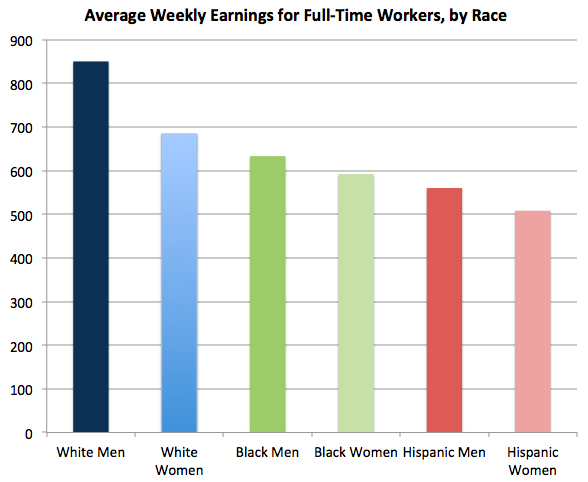


           Using the graph above, which was taken from the article “The Workforce is Even More Divided than You Think” this trend, is apparent. White men and women have the highest weekly income earnings, followed by Hispanic men and women, with black men and women once again coming in last.
            Along with stratification in the workforce, there is a trend of clustering in certain aspects of the workforce. At the top of the socioeconomic pyramid, whites tend to dominate the managerial sectors of the workforce (Asians also account for nearly 20% of all surgeon/Physician jobs) Next Hispanics, who cluster in farming, grounds keeping, housing keeping , make significantly less than whites. Blacks, being at the bottom of this pyramid, tend to have a concentration in low paying professions such as security guard and bus driver. All information was taken from the U.S. Bureau of Labor 2012 report (see chart 3, p. 4)
            The first cause for this is networking. People have historically been more prone to creating connections with those of their own race, which helps explain why certain racial groups continuously dominate aspects of society. The Network Theory describes how ties create ethnic enclaves in certain aspects of society. The social network theory operates are people tend   to offer jobs and opportunities to their racial or ethnic peers than those of different races.
            Also, schooling differences play a major role in job opportunities. There is a direct correlation between how much a person makes and level of schooling attained. The following graphs show the relationships that whites and blacks have between their educational attainment and earnings. Whites, who are more likely to graduate high school and attend college, earning at least a bachelors, earn significantly more than blacks, who are less likely to graduate high school or attain college. Spanish lag behind at every level in the education system from high school to a bachelor’s degree, however those who do achieve the same schooling as their black counterparts tend to make slightly more.


Friday, October 17, 2014

Educational Attainment and Employment Opportunity


In the academic world, the last decade has heard the term “a professional degree is the new undergraduate degree.” This may reign true in a struggling economy with job opportunities becoming both more specialized and scarce by the year. However, this term is implied for the white population. The article “A Black College Student Has the Same Chances as a White High School Dropout, “A recent study done by Young Invincible, a national non-profit aimed at empowering young Americans, revealed a painful reminder of white superiority in the United States. The study, focusing primarily on the Bureau of Labor Statistics, as well as the U.S. Census revealed that African Americans need an extra two years of higher education to reach the same occupational opportunities as their white counterparts.
            The study worked to isolate the effects of race and ethnicity on the probability of obtaining similar jobs. What it revealed was that an African American who has obtained an Associate’s Degree, which requires completion of college courses, will have the same probability of getting a job as a less qualified white person who has a high school diploma. This reveals an unfortunate achievement gap tilted in the white populations favor.
closing education gap 1
  The numbers in the graph above reveal the inequality between whites and blacks in the hiring process in regards to education attainment. Where the gap is most dramatic is in those with not high school diploma. Blacks with no high school diploma are nearly 15% less likely to receive employment than whites. The graph however reveals a trend. Possibly of obtaining a job seems to become more equal with the higher amount of education received. Blacks with a high school diploma are about 12% less likely to have a job than whites, while having some college lessens the gap to about 10%, associates about 6%, while bachelors lessens the achievement gap to less than 5%. With the highest professional degree, there is a very small gap at about 2%, showing that in today’s society, the way to lessen inequality in the hiring process for blacks and whites is to stay in school and earn advanced degrees, which is more attainable for whites for a number of different reasons including high school quality, connections, etc…
            Naturally, with employment opportunities being more prevalent for whites, unemployment has a more significant impact on the black population. A study done by the Young Invincible group looked at blacks and whites ages 18-34 during the great recession of 2008, and what they found was revealing of racial inequality. Not taking education into account this time, blacks were 16.6% likely to be unemployed, while whites were less than half that number, falling at a 7.1% unemployment rate.
            The graph below reveals that after the peak of the recession, from November of 2007 to May of 2014, though the numbers seemed to move in tandem with one another, whites maintained a higher percentage of employment,  at times as much as 10%, further showing the favoring of the white population in the achievement gap, even during times of economic failure. 
 closing education gap 2

Wednesday, September 24, 2014

Blog #1


            Race and the hiring process has historically been a widely debated aspect of society. The past century has seen vast advancements in affirmative action, hiring quotas, and ultimately the diversification of the workplace, however there is still much controversy and debated regarding the hiring process and its fairness. White privilege is believed to have a strong presence in the decision of who is offered a job, and looking at statistics its overwhelmingly evident that those who fall under the ethnic category of white have it easiest in trying to land a job. According the Bureau of Labor Statistics, whites are second in population percentage in the labor force, are nearly twice as likely to have higher education attainment before getting hired than blacks and Hispanics, and have the lowest rates of unemployment amongst all races in America. There is no doubting that the color of one’s skin and ethnic background play a role in the hiring process.
            Acknowledging the effects of ethnicity on landing on a job, research has shown that referrals hold even more weight than the color of one’s skin. A referral is this case is simply a recommendation of a worker by an employee, and most commonly involve promoting of a person’s ability or past experiences. Networks, Race, and Hiring, an article done in 2009 published in the American Journal of Sociology, explores aspects of the hiring process and specifically the effects of references on getting hired for people of different ethnicity. According the article, blacks, Hispanics, any anyone who is not deemed white or Asian to some extent are believed to be in a viscous circle of getting sucked into the “wrong network.” What is meant by wrong networks is that although references and networking is an effective way to land a job, amongst minorities, these are ethnic networks of low wage, dead end jobs. This trend then continues, as friends and family will be referred by people of similar ethnic back rounds, and mobility in the job market will be limited, causing stagnation in the social hierarchy for ethnic groups.
            Another important aspect of referrals is their consistency across racial groups. Statistics in the article have revealed that once referred, a person’s ethnicity tends to disappear, no matter what their background, thus altering the entire hiring process. Once referred, the employer’s initial reaction to the job seeker is changed, as they have e per-conceived notion on what kind of worker the person could be, and what they could bring to the company, solely based off of what was said in their referral. This stamps stereotypes, stigmas, and labels, and other preconceived notions based on a person’s race, showing the significant ability of the referral.
            What makes referrals so versatile in the hiring process is that any employ can give one out regardless of their ethnicity. However, just as actually receiving job offers, referrals tend to hold more weight hen given by a person considered white, showing the inequality in the job market. Those who are not white find jobs far more through referrals than through any alternate means of obtaining a job. With the imbalance of referring power tiled towards whites, in a world where non-whites are almost completely reliant on referrals, social isolation can occur, as an ethnic group will be confined to a series of low paying, low status jobs.
            One may think of a job hiring process as a meritocracy, but without referrals, there is much more that meets the eye regarding race. In Offering a Job:Meritocracy and Social Networks, a research is conducted at a tech company in Silicon Valley. Hiring in the job market was analyzed to see if using merit as a control, there would be any trends worth noting. The hypothesis reigned true, at the longitudinal study showed that 10% of those hired were white, double that of the 4.5% blacks who were hired, and still significantly higher than the 6% Asians, showing that when those with similar back rounds are vying for the same job opportunity, white advantage rears is evident.
            White advantage also applies to the all powerful referral. Referrals are largely based off of legitimacy, more valid the person giving the referral, the stronger it is.  That being said, finding a job has a lot to do with ones network. This applies to white privilege as whites are generally born into families with more networks than minorities, who experience a “lack of economic resources and personal networks,” (Fernandez, 2006). This allows for whites to have less trouble getting job offers, allowing smooth social mobility, where those with different ethnicity and races are not given the luxury of having strong connections so readily available.


Wednesday, September 3, 2014

Posts for the class begin!

You will notice that labels have now been created for the posts that you will construct. You MUST label all posts--please select from the given labels rather than creating your own.