Tuesday, October 21, 2014

Ebola: Stiring up Racism

       As Ebola continues to make its way into everyday news and into the lives of many families, people continue to question how and if this disease will be treated. As the disease spreads to the United States and now throughout parts of Europe, the topic of racial profiling plays a significant role in people's belief towards the treatment of Ebola patients.

       Since Ebola is generally portrayed as originating from African, West African, or other countries that are made up of mostly blacks, colored patients in the United States often feel as though they are being blamed for taking the disease across borders, regardless of the fact that there is no link to race and the disease. As a result, the families of colored patients that have deceased from Ebola are beginning to accuse the American health care system of racism.
   
     A recent article in the New York Times tells the story about a Liberian man named Thomas Duncan and his outraged nephew, Josephus Weeks. A few weeks back, Duncan attained Ebola in Liberia, unbeknownst to him.


Thomas Duncan
 Weeks explained to the Times that Duncan made  a stop at the Texas Health Presbyterian Hospital in Dallas with flu-like symptoms. He explained to the physicians that he was indeed on his way to the United States from Liberia. Duncan, however, did not have nearly enough money to pay for hospitalization, nor did he have any health insurance. Weeks explains the situation by stating, "...he was a man of color with no health insurance and no means to pay for treatment, so within hours he was released with some antibiotics and Tylenol" (Kozlowska). Experts say that if Duncan was turned away by the hospital for his race and lack of insurance, it was not inconsistent with the practices that they have seen by physicians in the past.  However, because of the disparities in treatment of black patients in the United States health care system, “there’s cause for suspicion that when a dreaded disease such as Ebola strikes and the visible face of the victims are black then the racial double standard instantly kicks in"(Kozlowska).

         Seeing as there exists a belief of disparity in treatment of colored patients in the United States health care system, many people have developed the suspicion that a large number of physicians practice racism. When asked about the treatment among Ebola patients throughout American hospitals, colored patients often report cases of racism where the white patients get preferential treatment and often take precedence over the colored patients in terms of care and attention.


 This illustration, by artist Andre Carilho, expresses the extent to which some people, such as Weeks, view the American health care system in their treatment of black patients. The picture depicts rows of hospital beds that hold all black patients except for one, who is white. The only patient that is receiving attention is white, while all of the black patients lay unattended to and uninterested by the media.


     Weeks continues to make his arguments about the racism among the physicians in Dallas by asking the question of how it is possible that all white patients are receiving proper care, while his uncle, a colored patient, received medicine 8 full days after visiting the hospital. Dr. Anthony Fauci, a world renowned physician, responds to Mr. Weeks' claims by stating that he completely understands how he feels. Many people, when losing a loved one, look for answers and search to obtain them with misguided views as a result of dealing with the pain. Although Weeks would fail to believe this to be true, Fauci believes that the initial misdiagnosis was not a result of racism, but rather merely a mistake, and that once the proper diagnosis was made, Duncan received excellent care (Wright).


I strongly recommend that you view the Video It very interesting to see how passionate people are becoming about the topic of race and mistreatment of patients. Later on in the article, author Robin Wright records the reaction of this mishap by Duncan's girlfriend, Louise. She stated that she was praying to God to at least give Duncan a chance by providing the care that American folks are receiving. What is interesting is that she complains about two white missionaries who were affected in Africa and that once they got back to the United States, they immediately received proper care. After reading these articles and watching the videos it is difficult to see how a misdiagnosis of a colored male from Liberia does not constitute any possibility of racism.

      Something that struck my attention was that Dr. Fauci stated the Dallas hospital which Duncan visited has a history of dealing with multicultural patients. Obviously, this case is held in higher regard than most because it deals with such a recent, nationally-feared disease like Ebola (Wright). This situation reminds me of several Supreme Court practices that we read about in the New Jim Crow. The Supreme court made it so that in order to prove racism in the police force, one had to have concrete evidence. However, it is essentially impossible to prove someones morals, especially when they are denying accusations. Based off this idea, it is possible that racism does indeed exist in the health care system in which it is incredibly difficult to prove based on someones 'honor'. Just a thought!

 So I wonder: Is this the case of a simple misunderstanding or is there a much deeper, more racism-based explanation?


Work Cited:

Kozlowska, Hanna. "Has Ebola Exposed a Strain of Racism?" New York Times, n.d. Web. 21 Oct. 2014.


Wright, Robin. "The Implicit Racism in Ebola Tragedy." CNN. Cable News Network, 01 Jan. 1970. Web. 20 Oct. 2014.



Using Comedy to Address Racism

       One of my favorite forms of comedy is satire.  The definition of satire is: the use of humor, irony, exaggeration, or ridicule to expose and criticize people's stupidity or vices, particularly in the context of contemporary politics and other topical issues.  One of my favorite source of satirical comedy is the show South Park.  I know countless people that absolutely HATE the show.  They think it is the most inappropriate, most vile, most ignorant thing on TV.  Unfortunately, these people only look at the surface of the show and don't even try looking any deeper.  Under its "brain dead" and "stupid humor" exterior is a serious satirical interior.

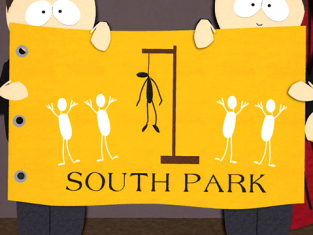
       While most of the episodes touch on important modern day topics, there is one specific episode (Chef Goes Nanners S04E07) that I feel is most appropriate for our class:LINK TO EPISODE

                                                (screenshot from the mentioned episode)

       This episode is about whether or not the towns flag should be changed due to its racist appearance.  One of the black members of the town, Chef, is extremely offended by the flag and demands that it is changed.  Another member of the town, Jimbo, strongly believes that the flag is a major part of the towns history and should therefore not be changed.  Because it is such a touchy subject and they don't want to look bad, the town chooses to let the kids at the local school decide whether or not the flag should be changed.  The kids are told that they are to have a debate about the topic and to pick the side they want to argue for.  When two of the main characters, Stan and Kyle, choose to be on the side that supports the flag, Chef ridicules them and they are seen as racist.  When the debate starts, the side arguing that the flag should change makes their statement.  They argue that, "Often times it is prudent to change history.  As times change we hope to grow and as we grow our rules must change, it is a natural part of evolution".  When it is the other side's turn to argue against the changing of the flag, they argue that, "the fly shouldn't offend anyone because killing has been around since the beginning of time.  All animals kill and the animals that don't kill are stupid...so people should not be so upset about killing".  Chef immediately criticizes them for missing the point of the argument.  The kids explain that they didn't pay attention to the color of the peoples' skin because they didn't think it was important.  Chef then realizes that the kids didn't see the flag as racist because they didn't see it as four white people hanging a black person, but as five people.  The episode ends with both sides making a compromise to keep the flag but change the color of the peoples' skin.
(the changed flag)

       This episode does a great job addressing certain issues with racism.  One thing it addresses is how racism can be taught, mainly by adults to children.  When the kids explain to chef how they didn't pay attention to the color of the peoples' skin, he tells them that the flag is racist and they respond in a way that makes it seem as though they were wrong for thinking that it wasn't racist and that Chef was telling them the right way to look at it.  Another issue this episode addresses is the general public's fear of talking about racism.  In the episode, when any of the general public is asked about their opinion on the debate, they are always indecisive and afraid to offend either side.


Interracial couple arguing: Would you intervene?


This is the video that ABC News posted on Youtube about 4 years ago to test if people would intervene while interracial couple arguing in public. The director designed the experiment groups into two different kinds. The one with the White abusive man while the victim is African American, the other one is contrary. And both of the situations were happened as the man abusing the woman.

Turns out there were more women intervene in the "White-African American" arguing than they did to the other one. And we can see from the video that even there are some women intervene between the second couple, they were just asking if the woman need help, instead of yelling at the man and going forward to stop him. Even some men choose to pass by the second couple, which is the "African American-White" group. However, when the abusing gets physical, some bystanders started giving strong responds on what they saw.

The phenomenon above interested me a lot, and it made me want to ask what if you were in the video, passed by these kind of couples, would you intervene or which one group would you intervene? And what would you say to them? 

Take a look at the interview of those bystanders and the researchers, there is an obvious truth that if the abusing man is African American, then to those people who are trying to intervene, there exist more recessive threats. That might be an important reason that most interracial domestic violence happened between the couple which are in the same situation of the second experiment group.

To intervene, at the very first, people need a lot of courage. In my point of view, mostly, people who overcome their fear and intervene those couple are motivated by their "strong power", like having a dog accompanied or much taller than the abusing man. And the video also shows the audience a good part that nowadays more and more people are able to broke the racial stereotypes and getting into a positive color-blind situation. 

This is just a small test of would bystanders intervene interracial couples' argument, that might relate to how people see the phenomenon of interracial couples and maybe the domestic violence.


We are the Indians, Not Native Americans


       Many American Professional and collegiate sports teams are branded and have millions of dollars, creating mascots out of the heritage of Native Americans. Last week I reported on a statement that Barrack Obama gave on the logo of  the National Football team the Washington Redskins. In a very short statement Obama says that “If I were the owner of the team and I knew that there was a name of my team even if it had a storied history that was offending a sizeable group of people, I’d think about changing it,” In my opinion Obama was being generous by saying I'd think about it, this is a change that is long over due and is not only offending a sizeable group, The Redskins are wiping away the real identity of Native American Culture. Although not widely publicized, there are over 566 recognized Native tribes, that are all located within in North America. Those tribes are subjected to harmful and negative stereotypes when they are labeled as Indians by Sporting Franchises. These stereotypes are then reinforced by the a believed bond between the fans, organization, and city.  This bond only furthers rips apart the Native Americans from their cultural.

     Arguments that some Mascots that portray Native Americans, Such as Florida States Chief Seminole, are authentic and in fact help with awareness of Native American tribes and cultural practices are in my opinion completely inaccurate. University of Illinois was forced to stop using their mascot Chief Illiniwek in 2007 after years of fighting on both sides. The argument of the university was that not only was "The Chief" a cornerstone of the Universities Athletic history but also is a sign of cultural awareness by the university for Native American people. The Mascot performed a danced that wads suppose to be a traditional tribal dance, and also wore formal head wear and feathers. These "Traditional Practices" were later found out to just to be different movements and the attire had no historical relation to any Native tribe. These Images of Native Americans dancing around were all too common and is a constant fight even now in 2014.

WORKS CITED

http://articles.chicagotribune.com/2013-10-23/news/chi-u-of-i-works-out-deal-on-use-of-chief-illiniwek-20131023_1_chief-society-roger-huddleston-the-news-gazette


http://www.ncai.org/attachments/policypaper_mijapmouwdbjqftjayzqwlqldrwzvsyfakbwthpmatcoroyolpn_ncai_harmful_mascots_report_ending_the_legacy_of_racism_10_2013.pdf


.http://www.washingtonpost.com/local/president-obama-says-id-think-about-changing-name-of-washington-redskins/2013/10/05/e170b914-2b70-11e3-8ade-a1f23cda135e_story.html